Skip to content


Loading globe...

Advanced Mission Engineering for
Defense Operations at Chaos Scale

A platform built to improve mission analysis productivity through AI-driven simulation, agentic pipelines, and global-context analytics.

Execute the mission as if it were the hundredth.

Agentic Mission Engineering and Analytics at chaos scale

Proxim AI solutions transform mission analysis through simulation, adversarial modeling, and automation – all aligned with the commander’s intent and global context.

Analytics & State-of-the-Art AI

Adaptive learning, forecasting, and on-the-fly generative analysis.

Adversarial Modeling

Generate red-team scenarios and adaptively plan counter-strategies.

Collaborative Mission Platform

Multiple users can collaborate in real-time with AI-assisted decision support.

Synthetic Data Generation

Generate physically accurate sensor data and scenarios with global context.

Advanced Modeling & Simulation

Interface with existing or custom simulation environments.

Simulation-Linked Testing

Align simulations with real-world exercises and field tests.


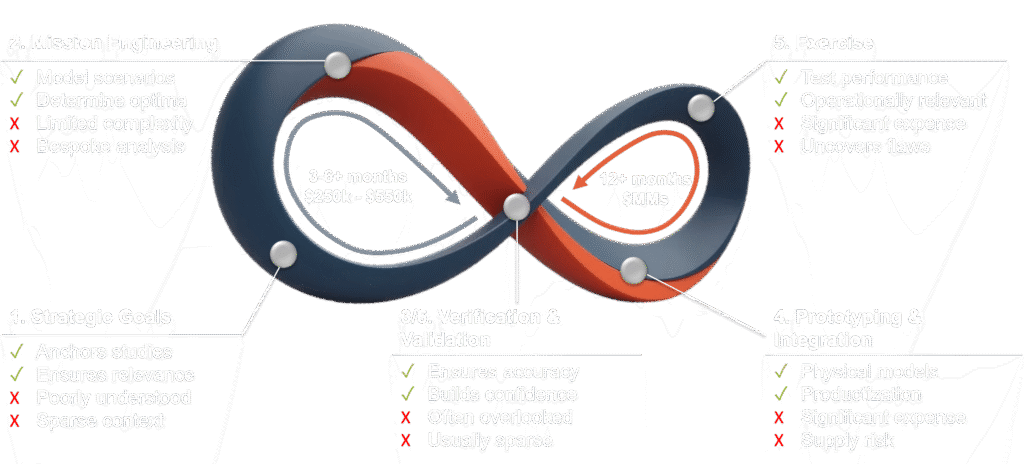
The Old Way is Broken

Our Vision

Execute the entire mission as if it were the hundredth time we’ve done it.


Bringing State-of-the-Art Agentic and Generative AI to Defense Modeling, Simulation, and Analysis

Our Expertise

Mission Engineering

Deep expertise in military mission analysis

AI/ML Development

Advanced machine learning and artificial intelligence R&D

Synthetic Environments

Synthetic remote sensing, geospatial, and scenario data


Ready to work with our team?


Frequently Asked Questions

At Proxim, “Chaos scale” refers to our ability to generate, analyze, and manage mission scenarios at levels of complexity and dimensionality that are simply not possible with current defense-focused simulation environments. While it may refer to the number of active entities in a simulation, “chaos scale” is more about the DIMEFIL-E dimensions that impact the real-world battlefield and their interactions with the scenario.

DIMEFIL-E: Diplomacy, information, military, economics, finance, intelligence, law-enforcement, and engineering artifacts.

Our platform was designed from the ground up to be simulator agnostic. We understand that different operational and R&D environments utilize different simulators, like AFSIM, NGTS, and other bespoke systems. Instead of forcing customers to adopt “yet-another tool,” our platform integrates with existing digital ecosystems, enabling faster adoption and lower barriers to integration.

No. Our platform is built on an independent stack that we developed and continued to advance through our own research and development. While we can interoperate with commercial AI APIs, our system is optimized to run fully on-premises, including air-gapped networks. We leverage specialized local language models, optimized training pipelines, and custom architectures to ensure our customers maintain control over their data, security posture, and deployment footprint.

Yes. Our platform automates some of the most commonly used forecasting and analysis techniques for defense modeling and simulation. Proxim extends this capability with automated scenario generation, enabling its users to focus more on outcomes rather than mundane development tasks. Furthermore, we developed our own agentic AI framework that is capable of generating new contextually relevant techniques on the fly, enabling even non-programmers to add to the platform’s functionality.

We “eat our own dog food.” Our team has a rich history of developing modeling, simulation, and analysis (MS&A) solutions for some of the Department of Defense’s most challenging problems. Unlike other companies that focus solely on MS&A practice or attempt to apply generic AI to defense domains, Proxim has specialized expertise in AI for defense MS&A. We have developed our own agentic AI framework, context-management methods, and synthetic data pipelines that address the entire research, development, test, and evaluation (RDT&E) pipeline.